
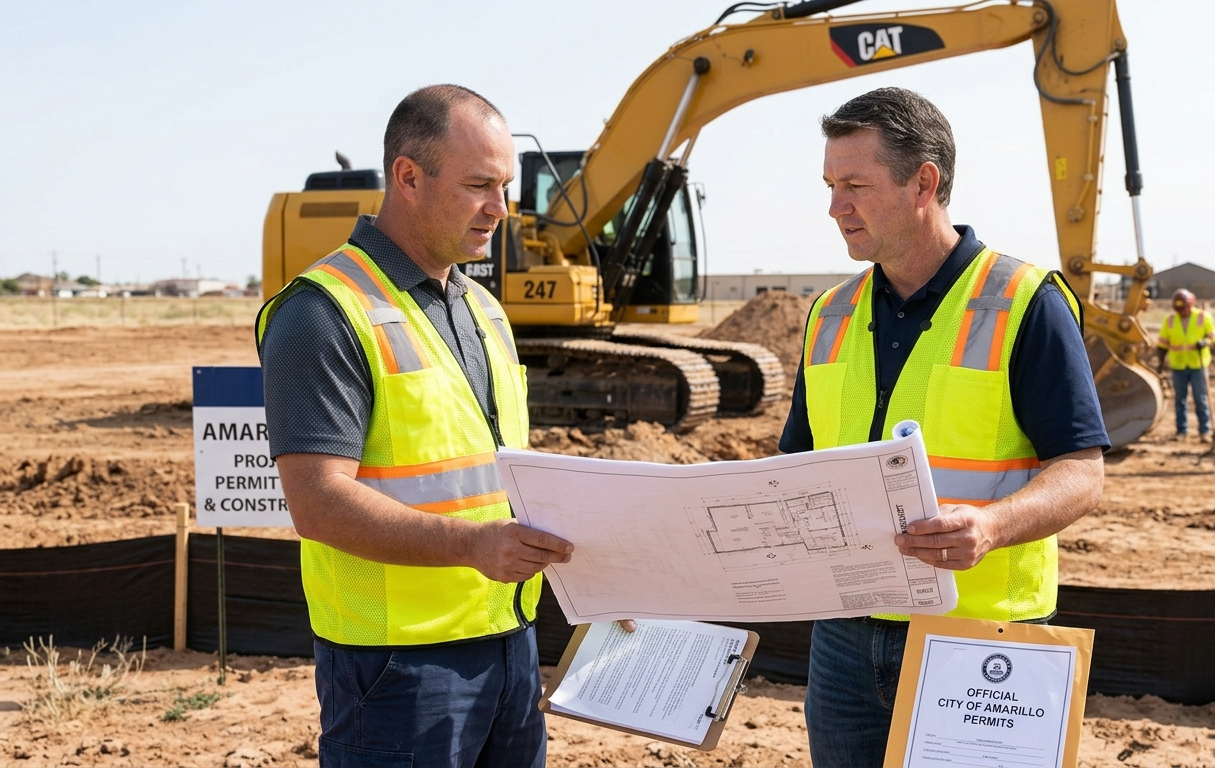
A building permit shows the City of Amarillo who is responsible for a construction project. In most cases, the contractor you hire is responsible for pulling permits for any work they perform on your property, so they should handle the permit from start to finish.
So, who pulls the permit? A licensed builder usually handles it because the person who signs the application becomes the person in charge of the construction in the city’s eyes. That person submits the plans, pays the fees, schedules the inspections, and fixes issues found during inspections.
Amarillo uses an electronic system for every building permit and contractor license. Therefore, a contractor whose license is not linked in the system cannot file at all. This helps protect homeowners from unlicensed work and unclear responsibility.
Starting work before the permit is issued can become expensive. According to the Building Safety Fees schedule, a first offense adds a $289 late fee plus the permit fee. A second offense within 24 months costs $576 plus 3 times the required permit fee.
Who Pulls Amarillo Building Permits? Explained in Detail
The contractor should pull the permit for work they perform. This keeps the permit, contractor license, plans, inspections, and construction responsibility under one qualified party.
An owner can sometimes apply for a permit. However, that owner becomes an owner-builder and accepts the same duties a contractor would normally manage. Amarillo allows this only when the property is your main residence and has a homestead exemption with the Potter/Randall Appraisal District. Rentals, flips, and investment properties do not qualify.
Once you sign as an owner-builder, you become the person in charge of the construction. That means you must handle every part of the project correctly.
- Every subcontractor becomes your responsibility, including verifying their license and insurance.
- Inspection scheduling, site access, and meeting the inspector become your job.
- Failed inspections come back to you, including corrections for framing or rough-in work.
- Worker injuries can create risk if the job does not carry general liability and workers’ compensation coverage.
This is why contractors who push permit responsibility to homeowners deserve close attention. When contractors ask homeowners to pull permits, it is a red flag because they may have licensing issues, insurance problems, or a reason the city will not allow them to file.
Why Contractor Permits Protect Homeowners
A contractor may offer a lower price if you pull the permit yourself. However, that lower price often means responsibility shifting, not real savings. It can become a transfer of legal liability from the contractor to you.
Homeowner permits are not cheaper, and they are not held to lesser standards than contractor permits. The city uses the same permit fee, plan review, inspection sequence, and code requirements either way.
Before hiring anyone, ask for their city license number and proof of insurance. Amarillo has coverage minimums for several contractor types, so a current license alone may not tell the full story.
As one of the established general contractors in Amarillo, Kindred Construction files permits under our own license. We believe homeowners should always know who owns the permit file before work begins.
Work That Requires an Amarillo Building Permit
Amarillo follows the International Residential Code with local amendments. The rule covers work to construct, enlarge, alter, repair, move, demolish, or change the occupancy of a structure. It also covers many system changes, so contractors must obtain the required permit before work starts.
Permit types often include:
- New residential and commercial construction.
- A structural or load-bearing alteration, addition, or major remodel.
- Reroofing and exterior envelope work.
- Window replacement, glass and glazing, siding, and insulation.
- Electrical, plumbing, and mechanical alterations.
- Water heater replacement and home energy backup and storage systems.
- Driveways, sidewalks, demolition, swimming pools, and manufactured home placement.
- Signs, including annual renewable sign permits.
Work That Is Usually Exempt
Some smaller projects do not need a building permit. Painting, wallpapering, tiling, and floor coverings usually remain exempt. Cabinet and countertop replacement, like-for-like replacement of existing fixtures, and routine maintenance also usually do not need a permit.
However, the Unified Development Code can still apply. For example, a small structure may not need a building permit but could still violate a setback rule. It is better to check first than correct the problem later.
Amarillo Building Permit Fees for 2026
Amarillo bases residential permit fees on square footage. Commercial fees usually depend on project value. The following amounts come from City of Amarillo Building Safety.
| Permit type | 2026 fees |
| New build permit | Square footage × $0.50 |
| Remodel or addition | Square footage × $0.32, or $135 minimum |
| Residential plan review and application | $81.00 |
| Commercial application fee | Construction value × 0.0014, or $81 minimum |
| Commercial permit fee | Construction value × 0.0037, or $135 minimum |
| Roofing permit, commercial | $173.00 |
| Stand-alone electrical, plumbing, or mechanical | $68.00 each |
| Solar permit | $216.00 |
| Re-inspection fee | $68.00 |
| Expedited review fee | $605.00 |
| Technology fee | $13.00 |
Trade permits need separate filing for electrical, plumbing, and mechanical work. Each permit follows its own inspection sequence. Commercial jobs may also include Fire Marshal alarm, sprinkler, and hood suppression fees.
Electronic Permitting and Contractor Licensing
Amarillo now handles permitting and contractor licensing fully electronically through MGO Connect. The portal handles applications, payment, plan uploads, inspection requests, and license records.
A contractor must link an active license before filing. A contractor whose license is not linked in the system cannot file at all. This is one reason homeowners should not accept vague statements about permits being “handled later.”
License rules also change by trade:
- General and new residential contractors need city licensing, although the city does not require a surety bond or liability minimum for those two license types.
- Residential remodel, insulation, and residential roofing contractors need a $20,000 surety bond.
- Residential roofing needs $300,000 in general liability, while commercial roofing needs $1,000,000.
- Electrical, plumbing, and HVAC work requires state licensing plus city registration.
- Irrigation, house moving, sign contractors, pool, and glass and glazing contractors have separate city ordinance requirements.
You can check state licensing for trade work through the TDLR License Data Search before signing a contract.
Plan Review and Inspection Requirements
Plan review often takes 7 to 10 business days after the city accepts the application and receives payment. A resubmittal may take 5 to 7 business days. Master plan projects can move faster after approval, although the first review may take 2 to 3 weeks.
Most projects move through foundation, framing, rough-in, insulation, and final inspections. An approved set of plans must be present on the construction site so the building official can review them during inspections.
Masonry inspection is mandatory before installation of masonry veneer. The inspector checks the base flashing course and weather-resistant sheathing paper before the veneer covers that work.
Why Applications Get Rejected
Simple mistakes can delay a project more than people expect. Common problems include:
- Missing setback dimensions on the site plan.
- A site plan without a scale and a north arrow.
- Building inside utility and drainage easements.
- Missing contractor license information.
- Foundation details that ignore the Panhandle Residential Foundation Manual and high-plains soils.
- Filing under the wrong record type.
A wrong record type leads to rejection, and the review clock restarts from zero. One complete resubmittal usually moves faster than several partial updates.
What Happens With Unpermitted Work?
Unpermitted work can follow a property long after construction ends. The city may issue a stop-work order, and the contractor may need to open finished walls or surfaces so inspectors can confirm the work meets code.
Retroactive permits often cost more because the city must inspect work after completion. Texas sellers also complete a disclosure form that asks about permit-required work. Homeowners insurance may not cover damage connected to unpermitted work.
A certificate of occupancy may also be delayed if the contractor of record is not properly registered. This can affect move-in dates, resale, and final project payment.
Roofing Permits After Hail Damage
Traveling contractors often arrive after hail repair events. They must register before working inside city limits, and residents should always ask to see a contractor’s permit.
After the 2013 hailstorm damaged more than 30,000 homes, the Amarillo Chief Building Official reported that more than 50% of roof inspections failed. Many failures involved fuel-fired appliance vent pipes that crews disturbed during rushed reroofing. Those problems can create a carbon monoxide risk inside the home.
A roofing permit helps prevent that risk. During a re-roof, asphalt shingles must be removed before new roof covering goes on. The inspection can also verify carbon monoxide alarms and properly connected vent pipes.
Kindred Construction pulls the roofing permit for every re-roof we complete. That includes planned replacements and storm damage restoration. If you are concerned about storm chaser contractors, our guide explains what to check before you sign the contract.
Questions to Ask Before Hiring a Contractor
Use these questions during the estimate meeting:
- Which city license number will you use for the permit?
- Are trade permits for electrical, plumbing, and mechanical work included in this price?
- Who handles inspection scheduling and meets the inspector on site?
- Will you provide the issued permit and final inspection sign-off?
Across general contracting, residential and commercial roofing, and barndominium builds, Kindred Construction manages the permit process as part of the job.
With 15+ years in business, 3,000 roofs completed, and 47 trained craftsmen, our team files, tracks, and closes the permits needed for your project. We are a family-owned licensed builder at 5410-A Bell St in Amarillo, serving Wolflin, Sleepy Hollow, Westover Village, Hillside Terrace, and the Tascosa office corridor.
As one of the general contractors in Amarillo that handles roofing, restoration, and full builds under one license, we make the permit process clear from the start.
Contact Kindred Construction to schedule a free on-site assessment.
Frequently Asked Questions
1. Can a Homeowner Pull a Building Permit in Amarillo?
Yes, but only for a primary residence with a homestead exemption with the Potter/Randall Appraisal District. The owner then takes responsibility for code compliance, inspections, subcontractors, and job-site safety.
2. Do I Need a Permit to Replace My Roof in Amarillo?
Yes. Roof replacement needs a roofing permit. The city may inspect the home for carbon monoxide alarms and fuel-fired appliance vent pipes after tear-off.
3. How Long Does It Take to Get a Building Permit in Amarillo?
Initial plan review usually takes 7 to 10 business days after acceptance and payment. Follow-up reviews often take 5 to 7 business days. A complete application avoids delays from a resubmittal.
4. How Much Does a Building Permit Cost in Amarillo?
Residential permits use square footage. New builds cost $0.50 per sq ft, while a remodel or addition costs $0.32 per sq ft with a $135 minimum. Commercial work uses project value, and trade permits have separate fees.
5. What Happens if My Contractor Starts Work Without a Permit?
The city can charge a $289 late fee for a first offense. A second offense within 24 months can cost $576 plus 3 times the permit fee. The project may be red-tagged, stopped, and delayed until it passes inspection.