Has a spring storm ever left dents on your car and made you wonder what it did to your roof? In West Texas, that worry comes back every year. According to the Insurance Information Institute, Texas had 902 major hail events in 2025, more than any other state.
That concern leads many homeowners to consider hail resistant shingles class 4 when they need a new roof. For most homes in the Panhandle and South Plains, the upgrade is worth it if you plan to stay for several years and your insurer gives a credit for it. Still, a Class 4 rating has limits, and the right choice depends on your roof, your policy and your budget.
Below, Kindred Construction explains what the rating means and how much hail these shingles can handle. You will also learn how Texas insurance credits work and when the extra cost does not pay off.
What Class 4 Hail Resistant Shingles Really Are
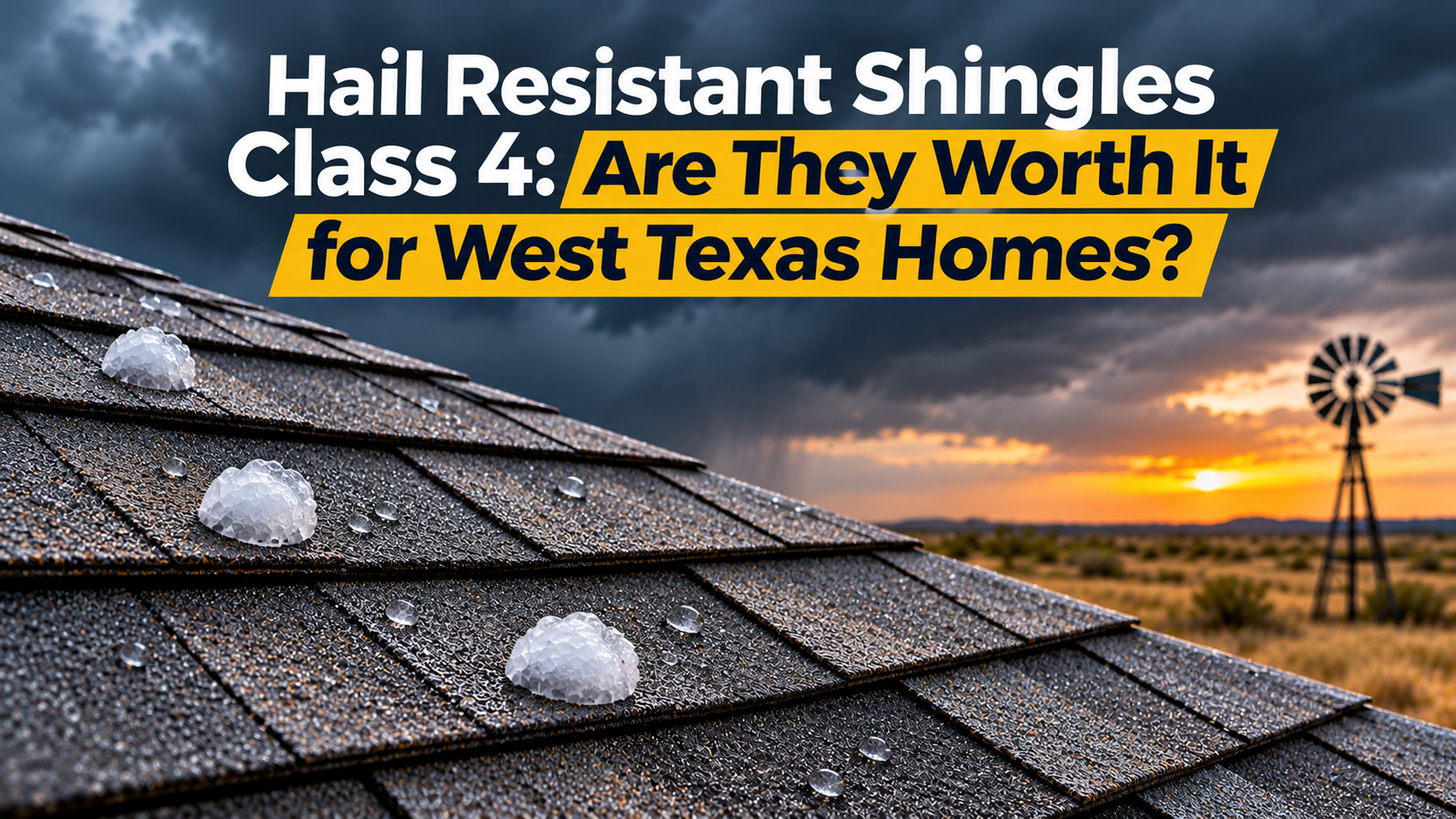
Class 4 hail resistant shingles carry the highest impact rating under UL 2218, a lab test for roof coverings. The Texas Department of Insurance explains that tested roofing materials fall into Class 1, 2, 3 or 4. A Class 4 roof covering receives the highest premium credit.
How the UL 2218 Steel Ball Test Works
In this test, a lab drops a steel ball twice on the same spot of a shingle. To pass, the shingle must show no crack, split or tear through its back. Each higher class uses a bigger ball dropped from a greater height, as the table shows.
| UL 2218 Class | Steel Ball Size | Drop Height |
| Class 1 | 1¼ inch | 12 ft |
| Class 2 | 1½ inch | 15 ft |
| Class 3 | 1¾ inch | 17 ft |
| Class 4 | 2 inch | 20 ft |
Some products are also tested under FM 4473, a second impact standard. Either way, Class 4 is the top level a roof shingle can earn.
What Makes a Class 4 Shingle Tougher
Most class 4 impact resistant roof shingles use one of these 2 approaches to help resist damage:
- SBS-modified asphalt: Manufacturers blend rubber-like polymers, called styrene-butadiene-styrene, into the asphalt. This helps the shingle flex and recover when hail hits, instead of cracking.
- Reinforced backing: A polymer mesh or reinforced mat on the back helps hold the shingle together. It also helps stop small cracks from spreading after an impact.
What Size Hail Can Class 4 Impact-Resistant Shingles Handle?
A class 4 shingle passes UL 2218 testing with a 2-inch steel ball. However, that does not guarantee protection from every 2-inch hailstone. Real hail differs from a lab ball, and strong wind adds another concern, so the rating cannot remove all risk.
Here is what independent research adds to that test rating:
- New shingles handle common hail well: IBHS testing shows that most new asphalt shingle products should withstand the typical energy of 1.5-inch hail.
- Elevation changes the hit: The same IBHS research explains that thinner air at higher elevations lets hail strike harder. A 1-inch hailstone in Denver has the same energy as a 1.2-inch stone in Dallas. IBHS has not yet tested whether this changes damage levels.
- Impact-resistant products are not all equal: To compare products, the Insurance Institute for Business & Home Safety buys shingles from stores and tests them with realistic hail. Its ratings show that not all impact-resistant shingles perform the same.
- Top-rated products go further: According to the FORTIFIED Roof program, shingles rated Good or Excellent by IBHS outperform typical Class 4 shingles. That holds when they are tested against realistic hailstones.
- Age weakens every shingle: Years of sun and heat slowly dry out asphalt, making shingles less flexible. An older Class 4 roof can crack under hail that the same roof would have survived when new.
Hail larger than 2 inches can still crack shingles or cause dents and granule loss. Not sure whether past storms already hurt your current roof? These signs of hail damage on a roof can help you recognize problems early.
As a roofing contractor in Amarillo, Kindred Construction checks each slope and photographs the damage we find. Then we explain whether a Class 4 upgrade fits your home. That way, you can decide with a clear picture of your roof’s condition.
Class 4 Impact Resistant Shingles vs Class 3 and Standard Shingles
Class 4 impact resistant shingles give the most impact protection of any shingle class. Class 3 is one step below, while standard architectural shingles carry no impact rating at all. Here is how the three compare for a West Texas home:
| Feature | Standard Architectural | Class 3 | Class 4 |
| UL 2218 test passed | None for unrated products | 1¾-inch ball from 17 ft | 2-inch ball from 20 ft |
| Hail protection | No rated impact protection | Lower tested impact class | Highest tested impact class |
| Texas insurance credit | Usually none | Smaller, if offered | Highest credit class |
| Upfront cost | Lowest | Higher | Highest |
| Look from the street | Architectural | Same look | Same look |
| Best fit | Short stay, tight budget | Lower hail exposure | Frequent hail, long stay |
The gap between Class 3 and a class 4 impact rated shingle is easier to judge beside the full roof price. Kindred Construction includes both options in one written estimate, so you can compare them line by line.
Insurance Discounts for a Class 4 Impact Resistant Roof in Texas
A class 4 impact resistant roof can lower your homeowners premium in Texas, but the credit is never automatic. The Texas Department of Insurance says each insurance company sets the discount for each roofing class. Each insurer also decides which test criteria it accepts, how shingles must carry labels and which paperwork it needs.
Before signing a roofing contract, call your agent and get clear details on these points:
- Credit amount: Find out what discount your policy gives for a UL 2218 Class 4 roof. Also ask whether it applies to the whole premium or only part of it.
- Approved products: Some insurers accept any Class 4 product, while others accept only certain ones. Confirm the product on your estimate before you count on a credit.
- Required paperwork: The TDI form PC068 is the Impact-Resistant Roofing Installation Form, though insurers may require their own form instead.
- Cosmetic damage terms: Certain policies treat dents that do not cause leaks differently from functional damage. Read this part first, because it decides what a future claim pays.
Upgrading to Class 4 During a Hail Claim
If hail has already damaged your roof, replacement through a covered claim can be a good time to upgrade. Many policies base replacement on materials of like kind and quality, subject to their terms. If you choose Class 4 instead, you usually pay the upgrade difference yourself.
Once you have records of the new roof, you can request the premium credit. The steps of a hail damage insurance claim stay the same either way.
Through our storm damage restoration service, Kindred Construction documents damage with photos and measurements. We can also meet your adjuster on site. This helps make the damage clear before you decide whether to upgrade.
Cost vs Payback: How to Decide if a Class 4 Shingle Is Worth It
Impact resistant shingles class 4 cost more than standard architectural shingles. However, the price gap changes with the product and the size of your roof. Instead of guessing what you might save, compare these 3 figures for your own home:
- Upgrade cost: Use the extra amount for Class 4 on your written estimate, rather than the whole roof price.
- Yearly credit: Take the premium discount your insurer confirms in writing, so your estimate reflects your policy.
- Hail deductible: Check the amount you pay if covered hail damage leads to a claim under your policy.
For example, say the upgrade adds $2,500 and your insurer credits $300 a year. At that rate, the credit covers the extra cost in a little over 8 years. If the roof also helps you avoid a covered claim with a $3,000 deductible, the savings could come sooner.
Since a new roof is a big expense, roof financing options can help you choose Class 4 now. With Kindred Construction, you pay over time instead of settling for a lower class.
When Class 4 Roofing Shingles May Not Be Worth It
Class 4 roofing shingles are not the right choice for every home. The upgrade can be harder to justify if any of these situations apply:
- Selling soon: If you move within a year or 2, premium credits may not cover the extra cost before you leave.
- No insurance credit: Without a discount, the financial benefit depends on avoiding repairs or claims. Those savings are less certain and may take longer to appear.
- Deck or ventilation problems: A top-rated shingle cannot make up for soft roof decking or an attic that traps heat. Address those problems first so the new roof has proper support.
- Wanting a different material: Some homeowners prefer metal for its longer service life. If that matters most to you, compare materials before choosing an impact class.
If metal interests you, standing seam metal roofing and stone-coated steel roofing are both worth comparing. You can also read how impact-rated shingles vs standing seam metal compare for Amarillo homes before deciding. Kindred Construction installs shingle and metal roofs, so we can explain both options for your home.
Installation Details That Decide How Class 4 Shingles Perform
A Class 4 rating describes how a shingle performs in a lab test. On your home, the surrounding roof system affects how well those shingles perform over time. For that reason, the installation needs careful attention to these details:
- Matching hip and ridge caps: Ridges and hips take direct hits, and some insurers require impact-rated caps there as well.
- Correct nailing: Overdriven or misplaced nails weaken shingles and can void the manufacturer warranty, so proper placement matters.
- Underlayment and flashing: Quality underlayment and properly installed flashing help keep water out if hail or wind gets past a shingle.
- Attic ventilation: Trapped heat ages asphalt faster, which makes proper airflow a concern during long West Texas summers.
- Product records: Your installer should provide the product name, a wrapper label photo and the signed installation form for your records.
Kindred Construction installs every roof to manufacturer specifications to keep your warranty intact. We also back our work with a 10-year workmanship warranty.
Our crews handle roof replacement in Lubbock and work as a trusted roofing company in Canyon. We finish most residential roofs in 1 to 2 days.
Protect Your West Texas Roof With Hail Resistant Shingles Class 4
Hail resistant shingles class 4 will not make a roof hailproof. Still, they give West Texas homes the strongest protection an asphalt shingle offers. They also qualify for the highest premium credit class in Texas when your insurer offers one.
The upgrade usually pays off when you plan to stay and your insurer confirms a credit. Correct installation to manufacturer specifications matters just as much.
Planning a new roof or recovering from a storm? Kindred Construction will inspect your roof for free and price Class 3 and Class 4 options side by side. Explore our residential roofing services or call 806-440-2167 to book your free inspection today.