
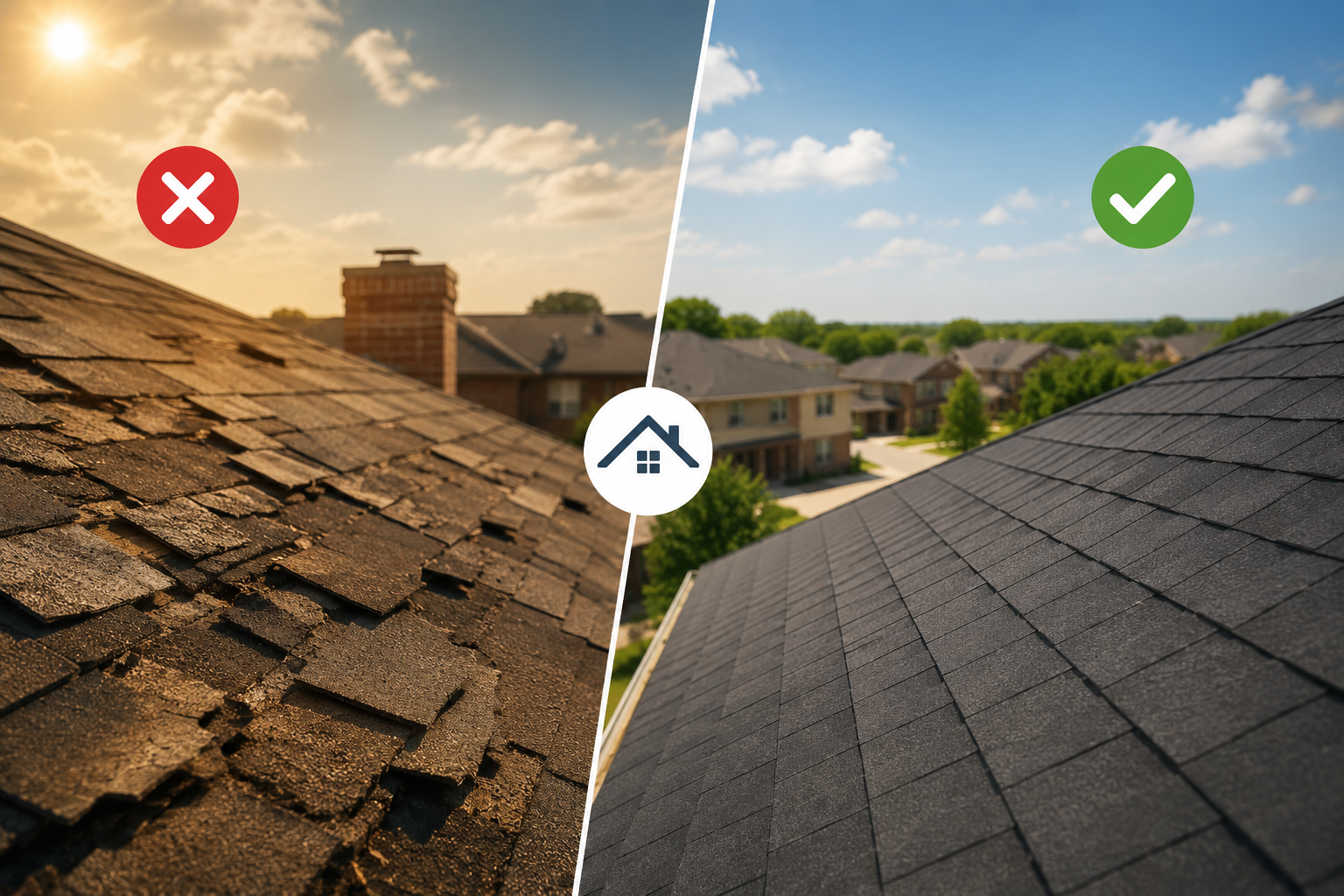
Two homes can sit four blocks apart, take the same storm, and have very different damage by morning. One needs a simple repair. The other needs a full roof replacement. That difference rarely comes down to luck.
Your build era, roof orientation, tree canopy, and workmanship and materials all shape how a roof performs. Federal climate records list 126 severe storm events affecting Texas since 1980, with losses above $1 billion each. Amarillo and the Texas Panhandle deal with a serious share of severe weather each spring.
When you understand why roofs wear out faster in Amarillo, you can protect your home and plan before the next storm decides your schedule.
What Really Decides Your Roof Lifespan?
A manufacturer warranty may say 30 years, but roof lifespan in the Texas Panhandle often looks very different. Many asphalt shingles last 15 to 20 years here because the weather puts every part of the roof under pressure.
Several things work together.
- Build era: A 1990s builder-grade 3-tab shingle roof was not designed for the hail impact many homes face today.
- Roof orientation: South and west-facing slopes get more afternoon UV exposure. They often show accelerated aging before the north side of the same roof.
- Tree canopy: Shade can help in summer, but branches also drop debris into valleys and gutters. Damp areas stay wet longer and may develop leaks.
- Workmanship and materials: Premium materials still fail early if the installer uses weak underlayment, misses damaged roof decking, or leaves flashing loose.
A professional roof inspection can catch small issues while they are still manageable roof repairs. If the same issue sits for years, it can turn into a tear-off.
Roof Age Changes Across Amarillo
Not every part of the city ages on the same clock. Amarillo neighborhoods developed in different decades, with different roofing systems, roof designs, and building standards.
| Neighborhood | Typical build era | Common roof situation now | What usually fails first |
| Wolflin Historic District | 1940s to 1960s | Older brick and wood-frame homes with several re-roof layers | Damaged flashing at chimneys, original soffit and fascia |
| Sleepy Hollow | 1970s through 1990s | Mature tree canopy and tight lot spacing | Moisture, debris, and weak attic ventilation |
| Bell Street Corridor | Mixed, with many 1970s homes | Heavy canopy load in valleys and gutters | Clogged drainage, then leaks at the eave |
| Westover Village | 1970s to 1980s | Mixed commercial and single family home properties near Coulter and I-40 | Wind uplift at ridges and edges |
| Hillside Terrace | 1980s onward | Direct exposure to afternoon storm cells | Granule loss, cracked shingles, and hail damage roof concerns |
| Tascosa Office Park | Commercial | TPO and modified bitumen flat roofs | Ponding and seam separation after heavy rain |
If your street was built around 1985 and your roof has only been replaced once, the age of the roof may already place it beyond the halfway point for this climate.
Kindred Construction serves areas across Amarillo with a close look at the actual roof. A search for a roofing contractor near me can produce many results, but a reliable roofing contractor should understand the conditions around your zip code, not treat every property the same.
Why Amarillo Weather Wears Roofs Down Early
Hail Comes Hard and Fast
The spring hail season usually runs from April through June. Strong supercell thunderstorms can produce golf ball to softball-sized hail, and large hail can bruise the asphalt shingle mat, remove granules, and leave hidden damage behind.
This is why a roof can look normal from the ground after storm damage. Hailstones may not create an obvious hole, but the hail impact can make a brittle shingle weaker. Over time, shingles lose flexibility, split, and allow water infiltration.
High Winds Lift Weak Areas
The flat terrain allows storms to build intensity before they reach Amarillo. During strong thunderstorms, winds exceeding 60 mph are common. Straight-line winds can cause real wind damage even when no tornado forms.
Blue norther cold fronts also bring sudden high winds. They lift shingle edges, break compromised sealants, and create wind uplift around ridges and edges. Missing shingles often mean nearby damaged shingles have also lost their seal.
Extreme Temperature Swings Work on Every Roof
Amarillo can move from freezing winter weather to triple-digit summer heat. These extreme temperature swings cause roofing materials to expand and contract. This thermal cycling, also called freeze and heat cycling, can loosen fasteners and shift flashing around chimneys, skylights and vents.
Over time, the movement affects roof decking, underlayment, drip edge, ridge cap, and every shingle course. That is why a roof can develop trouble even after a quiet year without major storm damage.
Signs Your Roof Needs Repair Before a Leak Gets Worse
Some damage is visible from the ground. Much of it is not. A roof inspection helps identify hidden damage before water reaches insulation, walls, or ceilings.
Watch for these signs your roof needs repair:
- Granules in gutters or loose grit at the base of the downspouts.
- Bald spots where the black exposed mat shows through.
- Curling, blistering, or cracked shingles across a full slope.
- Missing shingles after high winds.
- Rust, gaps, or loose pieces at the drip edge and ridge cap.
- A sagging roof deck or soft areas that suggest water has reached the decking.
- Damp attic insulation, water infiltration, or mold growth.
Kindred Construction provides a free roof inspection with photos, measurements, and clear findings. We give you the same honest answer whether you need roof repair in Amarillo or a replacement.
Roofing Materials That Hold Up Better Here
Different roofing materials give you different results under Panhandle weather.
| System | Realistic life here | Hail behavior | Best fit |
| 3-tab asphalt shingle | 12 to 15 years | Bruises and punctures easily | Budget replacement |
| Impact-resistant shingles, Class 4 impact-rated | 20 to 25 years | Better resistance to cracking | Most Amarillo homes |
| Standing seam metal | 40 years plus | May dent but rarely punctures | High-exposure lots |
| Stone-coated steel | 40 to 50 years | Holds up well under repeated strikes | Long-term ownership |
| TPO and EPDM | 20 to 25 years | Depends heavily on seams | Commercial buildings and flat roofs |
Across 214 hail-hit roofs our crews documented after major storms, asphalt shingles failed after an average of 13 years, while every stone-coated panel we inspected showed zero punctures. That is our field data, not a manufacturer claim.
For many homes, we recommend Class 4 impact-resistant shingles or 26-gauge standing seam metal with wind warranties above 130 mph. For owners who plan to stay long-term, stone-coated steel can reduce the replacement cycle.
Roof Repair or Replacement: How We Help You Decide
The right choice depends on the extent of the damage, not just one bad-looking area.
A single puncture, loose ridge cap, or damaged flashing may only need storm damage roof repair. However, widespread granule loss, soft decking, recurring leaks, or damage across several slopes often means roof repair or replacement has become the real question.
Past 15 years, many asphalt shingle roofs in this climate become expensive to patch again and again. A professional inspection helps you avoid spending on roof repairs that only buy one more season.
Our residential and commercial roofing team handles both residential roofing and commercial roofing. Every full replacement includes a 15-year workmanship warranty.
Insurance, Warranties, and Storm Documentation
A 30-year or 50-year manufacturer warranty does not promise that a roof will survive 30 Panhandle springs. Most warranties are prorated, and coverage often reduces as the roof ages.
Review your insurance policy closely. A windstorm and hail deductible may apply separately, and replacement cost coverage works very differently from actual cash value coverage.
The Insurance Institute for Business and Home Safety also provides independent hail guidance on how products perform under controlled testing.
Kindred Construction supports storm damage restoration with complete damage documentation and detailed scope reports. We also offer roofing financing and a free estimate, so a needed roof does not have to wait for a claim outcome.
Roof Maintenance That Can Extend the Life of Your Roof
Preventive maintenance cannot stop hail, but it can extend the life of your roof and reduce secondary damage after storms.
- Schedule a professional roof inspection twice each year and after quarter size hail or stronger storms.
- Keep attic ventilation clear, because trapped heat can shorten shingle life from underneath.
- Remove debris from valleys and gutters so heavy rain flows away from the eave.
- Trim branches back from the roof plane to reduce moisture and debris.
- Repair damaged gutters, soffit and fascia before water runs behind the roof edge.
Our exterior services team can repair those connected parts during a re-roof. If storm water has already entered the building, our water mitigation crews use extraction equipment and structural drying to stop secondary damage from spreading.
Your Roof Is Already Showing Its History
Your roof carries the record of every storm, heat wave, and cold front it has faced. Once someone walks the roof correctly, that record becomes clear.
Kindred Construction has completed more than 3,000 roofs, handled 1,200 storm repairs, and worked under this weather for 15 years. Call 806-440-2167 or book your free inspection today. We will explain what we find, whether you need a repair or roof replacement, and how much useful life your roof may have left.
Frequently Asked Questions
1. How Long Does a Roof Last in Amarillo?
When people ask, “how long does a roof last in Texas,” the honest answer depends on the material and exposure. Asphalt shingles often last 15 to 20 years in Amarillo. Class 4 shingles may last 20 to 25 years, while metal roofing systems can last 40 years or more.
2. Do Roofs in Older Amarillo Neighborhoods Fail Sooner?
Not because of the neighborhood name alone. Older homes may have multiple roof layers, aging flashing, mature tree canopy, and older attic ventilation. Wolflin Historic District homes often show these conditions, but any home can develop them.
3. Are Impact-Resistant Shingles Worth It in the Panhandle?
For most homes, yes. Class 4 impact-resistant shingles resist cracking better than standard asphalt shingles. Many Texas insurers may offer premium discounts, often around 10% to 25%, but you should confirm the current discount with your own insurer.
4. How to Tell How Old Your Roof Actually Is?
Start with closing documents, city permit records, and prior roofing invoices. Granule loss, curling, cracked shingles, and loose grit can also show that the roof is nearing its final years. A roof inspection gives you the clearest answer.
5. What Does Hail Damage Look Like on a Roof, and Should I Schedule an Inspection?
Hail damage may look like bruised shingles, lost granules, cracked areas, bald spots, or damaged flashing. Some hail damage stays hidden, especially after quarter-size hail. Schedule an inspection soon after a major storm, because early documentation helps with insurance and storm damage claims.