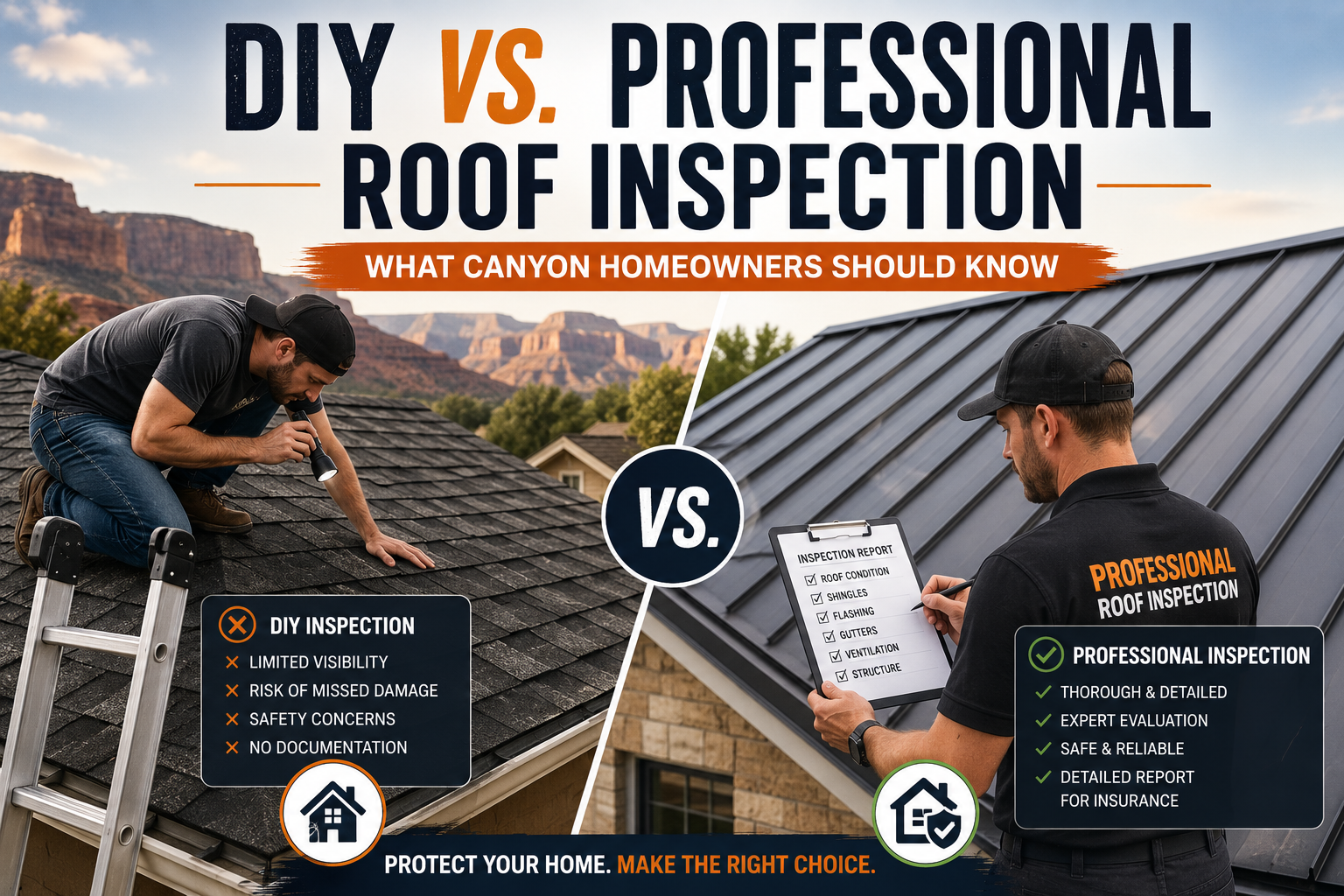
Can you inspect your own roof, or does the job need a pro? The honest answer is both. A careful DIY roof inspection twice a year helps Canyon homeowners catch clear warning signs before they spread. Still, a professional roof inspection finds problems that do not show up from the driveway, such as hail bruising, trapped moisture, and weak decking.
That difference matters. NOAA classifies a hailstone quarter size or larger as severe hail. A storm can damage the shingle mat without leaving an obvious mark from the ground. This guide explains DIY vs professional roof inspection, what each option catches, what it costs, and when a call can protect your home.
What a Roof Inspection Covers on a Canyon Home
A proper roof inspection looks at the full roofing system, not only the asphalt shingles you can see from the street. It includes the field of the roof, flashing around chimneys, vents and skylights, the drip edge, eaves, gutters, attic, and the underside of the roof.
The attic often tells us more than the roof surface. Water can stain decking long before you notice water stains on ceilings and walls. That gives you time to act before a roof leak becomes structural and interior work.
A DIY roof inspection is a visual examination you complete from the ground and inside the attic. A professional roof inspection is an evaluation of your entire roofing system by trained inspectors. It should end with photo documentation, an inspection report, and a written scope you can use with an insurance adjuster.
What Inspecting Your Roof Yourself Can Honestly Catch
Inspecting your roof yourself does not replace a professional visit. It does give you a useful early warning system, especially after storm season.
Start With a Ground-Level Roof Inspection
A ground-level roof inspection is safer and more useful than many homeowners think. Walk around the property slowly and look at every slope from more than one angle.
You may notice:
- Missing or damaged shingles, lifted or creased shingles, curling shingles, or loose asphalt shingles.
- Sagging areas, which can point to structural issues instead of a surface problem.
- Damaged ridge caps, a bent drip edge, or flashing that looks pulled away near a wall.
- Granule loss and shiny spots near the downspout, since that grit often comes from aging asphalt shingles.
- Clogged gutters, rust or sagging gutters, and fascia rot. Each one can look like a roof leak from inside the home.
- Circular impact marks, bruised shingles, cracked or punctured shingles, or buckled or blistered shingles after hail damage.
- Shingle tabs, exposed nails, or torn material in the yard after high wind.
Check the Attic Before You Make Any Assumptions
Bring a bright flashlight into the attic. Look for damp insulation or darkened decking around vent pipes and chimney chases. Daylight visible through the decking means water already has an open path into the home.
Also watch for discolored drywall near wall tops, water stains on ceilings and walls, and an unusually high attic temperature. Poor attic ventilation traps heat and can age your roof from underneath. If you see sagging rafters or decking, do not climb onto the roof.
Build a Simple DIY Inspection Kit
A useful DIY inspection kit does not need expensive equipment. For under $150, most homeowners can cover the basic check with binoculars at 8x to 10x magnification, a bright flashlight, gloves, a phone camera with the date stamp turned on, and slip-resistant shoes.
Use basic tools like a ladder and binoculars for viewing. Do not use them as a reason to walk the roof.
At Kindred Construction, we encourage customers to take photos and notes. When you already have a record, our crew can compare new damage with what was there before and give you a clearer answer.
Safety Limits Every Homeowner Should Respect
Climbing a ladder or walking on a roof brings real risk. OSHA says portable ladders used to reach an upper landing surface should extend 3 ft above the upper landing surface. That rule exists for a reason. OSHA ladder guidance also covers stable footing and proper setup.
Treat these conditions as never-climb situations:
- Do not go up after hail or wind while the roof is wet, loose, or covered in debris.
- Stay off a steep pitch and any roof with loose asphalt shingles.
- Do not climb if the attic shows sagging rafters or decking.
- Never work alone.
- Do not trust a safety harness unless you know how to secure and use it. An improperly secured safety harness does not protect you.
Foot traffic damages shingles, especially after hail bruising. What looks like a careful walk can break a weakened seal strip and create an active leak. That is why an insured, trained, equipped crew is the safer choice when there is any doubt.
What a Professional Roof Inspection Adds
Trained inspectors read the roof as one connected system. They check seals, seams, penetrations, ventilation, flashing, and roof deck condition together. A ceiling stain may sit far below the true entry point, so the visible stain does not always identify the real failure.
Professional equipment helps us see beyond surface level only damage:
- Drone photography captures every slope without unnecessary foot traffic.
- Thermal imaging and infrared cameras can reveal unusual temperature patterns.
- Moisture meters check water infiltration you cannot see.
- A certified moisture inspection can help detect sub-surface rot and mold before the repair grows.
A strong written report should name the finding, show the related photos, explain the priority, and provide an estimated repair scope. That documentation becomes valuable third-party evidence when you file an insurance claim.
Kindred Construction provides a free roof inspection across the Panhandle. Our roof inspections include photo documentation and a written scope, never a verbal guess at your front door.
DIY Roof Inspection vs Professional: A Clear Comparison
| Factor | DIY inspection | Professional inspection |
| Cost | Free, plus roughly $150 in tools | $150 to $350 typical, often free with roofing contractors |
| Coverage | Surface level only | Full structural and ventilation review |
| Tools | Binoculars, flashlight, ladder | Drones, thermal sensors, moisture meters |
| Safety | Higher risk to you | Insured, trained, equipped crew |
| Insurance value | Helpful photos, but limited alone | Third-party evidence and a written report |
| Time | About an hour | 2 to 3 hours of expert analysis |
The DIY roof inspection vs professional choice becomes simple when money enters the picture. A missing shingle may cost around $50 to fix today. If water spreads, it can become a $500 decking repair, then $5,000 in structural and interior work. In Canyon, a roof replacement can reach the low five figures, so early action matters.
Insurance, Warranties, and Documentation
Your own photos matter because they create a date record. They do not replace a contractor report when an insurer needs measurements and clear findings. The Texas Department of Insurance advises homeowners to document damage, stay available for the adjuster visit, and avoid any contractor who offers to waive your deductible. Texas law prohibits that practice. Texas Department of Insurance guidance also recommends protecting the property from further damage and keeping receipts.
Keep these points in mind:
- DIY repairs can voids manufacturer warranties, even if the repair seems to hold.
- Certified installation helps keep your roof warranty-protected.
- Your insurer may request a professional report before approving a full roof replacement.
- A documented maintenance history supports resale because buyers often ask for it.
- A 15-year workmanship warranty adds value only when the contractor clearly explains its terms.
Kindred Construction backs certified installation with a 15-year workmanship warranty. We also handle documentation through our storm damage restoration service. One project manager stays with your file from the first tarp to the final walkthrough.
How Often Canyon Homeowners Should Schedule Roof Inspections
For most homes, check the roof twice a year, spring and fall. Randall County homes face open terrain, strong wind, hail, and fast weather changes, so regular checks are worth the time.
A practical schedule looks like this:
- Run a spring check before storm season.
- Use a summer check for heat damage, curling shingles, and attic temperature concerns.
- Clean gutters in fall and check that flashing sits flat before freezing weather.
- Book a professional visit within 24 to 48 hours after a hailstorm or wind above 60 mph.
- Schedule an annual professional roof inspection once the roof reaches 15 years, when you buy or sell, or when it has never had one.
Canyon saw tornado and hail damage and disaster declarations in recent years. Rentals near West Texas A&M need the same care as owner-occupied homes. Our crews serve Canyon, Amarillo, and the rest of West Texas.
Damage Signs That Deserve a Call
Some issues deserve a professional visit, not another look from the driveway.
Cracked rubber pipe boots and splits around the pipe collar cause many quiet leaks. Step flashing no longer tight against the wall, split caulk lines at a chimney, moss and algae growth, and persistent roof leaks even after patching all deserve attention.
Hail works differently from wind. Hail can leave circular impact marks and bruised shingles. Wind can lift tabs and break the seal strip. Both issues can stay hidden until the next rain.
For help after a storm, read our guide to hail damage. If you need to choose a company, our guide to picking a roofing contractor explains what to check before you sign.
Roofing Material Changes the Inspection
Each material needs its own inspection focus.
Asphalt Shingles
Inspect asphalt shingles for granule loss, bruised shingles, curling shingles, and buckled or blistered shingles.
Standing Seam Metal
With standing seam metal, inspectors focus on seams and clips instead of the panel face.
Stone-Coated Steel Roofing
Stone-coated steel roofing needs close checks at panel laps and headwall flashing. Our systems carry a Class 4 impact rating under UL 2218 and a 120 to 170 mph wind rating. Some Texas insurers discount premiums for qualifying impact-resistant systems, but homeowners should confirm the details with their own carrier.
Other Roofing Systems
Wood shake needs checks for splitting, cupping, and moisture content. Low-slope commercial systems along the Highway 60 corridor need seam and ponding checks.
IBHS publishes impact-resistant shingle ratings that help homeowners compare products. Its fourth edition reviewed 24 products representing about 95% of the impact-resistant asphalt shingle market. Most earned a Good rating, while none achieved Excellent. A Class 4 upgrade can help, but it does not remove the need for roof inspections.
Get a Straight Answer Before the Next Storm
Searching for a roof inspection near me in Canyon usually means something already caught your attention. Maybe you saw a ceiling stain, granules in the driveway, or damaged shingle tabs after a storm. Trust that instinct.
A DIY walk-around can show you that something changed. A professional roof inspection explains what changed, where the damage sits, what it may cost, and whether insurance may apply.
Kindred Construction has served West Texas for more than 15 years. Our team includes 47 trained craftsmen, with 3,000 roofs completed and more than 1,500 storm repairs. As a licensed roofing contractor in Canyon, we inspect, photograph, and document before we quote. Call 806-440-2167 or contact us to book your free inspection this week.
Frequently Asked Questions
1. How Much Does a Roof Inspection Cost in Texas?
Paid inspections generally cost $150 to $350, depending on roof size, pitch, and access. Many established roofing contractors in the Panhandle, including Kindred Construction, offer a free roof inspection for homeowners.
2. Can a DIY Inspection Be Used for an Insurance Claim?
Your photos can help show when damage appeared. Still, carriers often need a professional report with measurements, photo documentation, and named findings. For a claim, DIY vs professional roof inspection documentation is not equal.
3. How Long Does a Professional Roof Inspection Take?
Most residential roof inspections take 2 to 3 hours of expert analysis, including attic access and photo documentation. Larger commercial and low-slope systems may take longer because drains and seams need individual review.
4. Is It Safe to Walk on My Roof After a Hailstorm?
No. Hail can weaken the shingle mat and loosen granules, so foot traffic may turn hail bruising into an active roof leak. Check from the ground and let an insured crew inspect the surface.
5. Can Hail Damage Cause Leaks Weeks Later?
Yes. Bruised shingles, loose flashing, cracked rubber pipe boots, and damaged seal strips can hold through one rain, then fail during the next storm cycle.