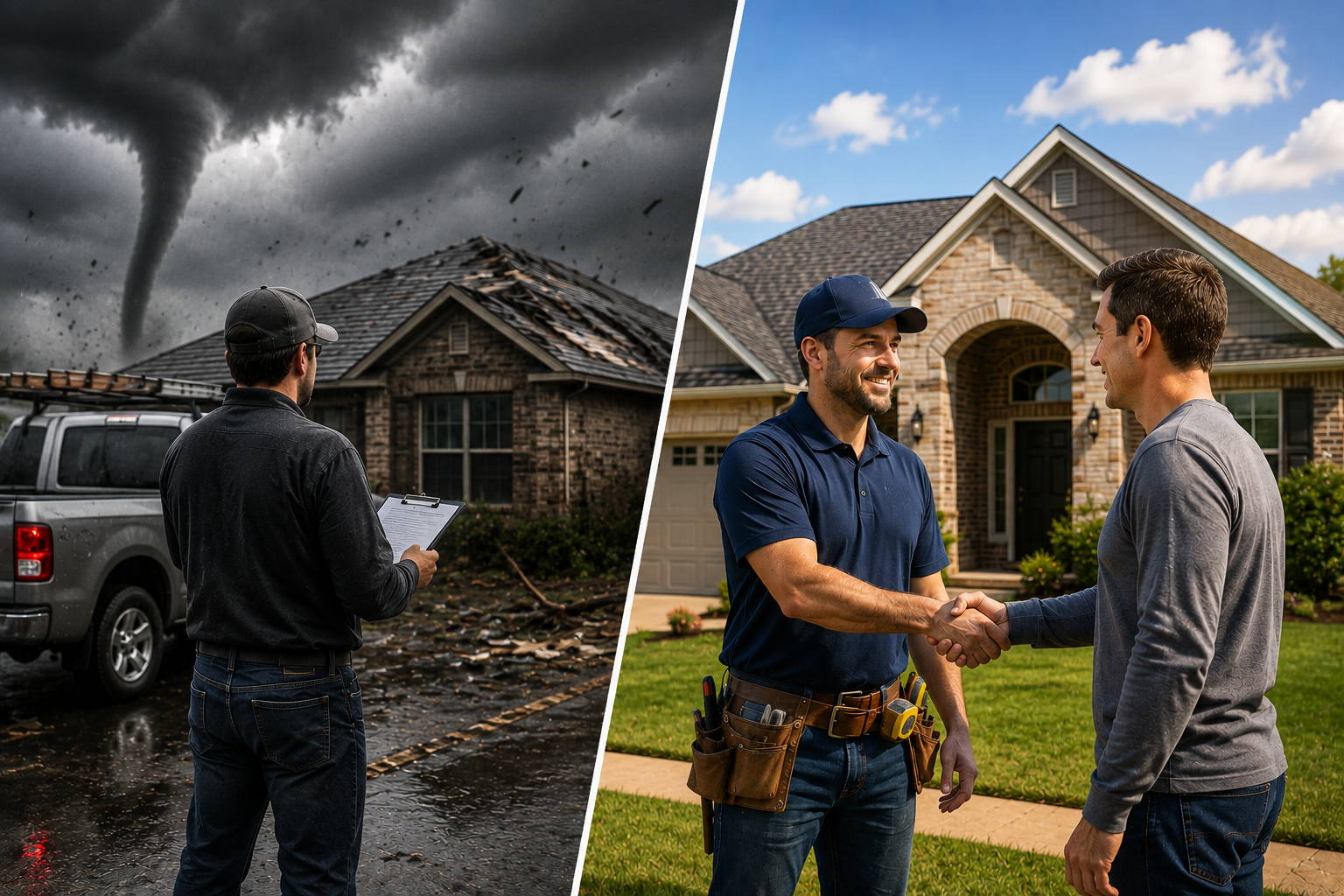
Did a roofer knock on your door the morning after the last Amarillo hailstorm, promising a brand-new roof for nothing out of pocket? That single knock fools more Texas Panhandle homeowners than almost any other roofing scam.
The Texas Department of Insurance warns storm-hit families to watch out for contractor scams and to try to use local contractors, because crews from outside the area flood West Texas after every major storm. People call them storm chasers, and they chase hail, not happy customers.
They sell fast, build cheap, and disappear before the next season. This guide shows you how these crews operate, the red flags to catch early, and why a rooted local contractor protects your home and your wallet far better.
What a Storm Chaser Really Is
A storm chaser is a roofing crew that travels from state to state, following hail damage and wind damage. These fly-by-night crews keep no permanent address in Amarillo, no real local team, and no reason to stay. Most go door-to-door within days of a storm, while shingles still litter your yard.
These crews tend to share a few traits you can spot fast:
- They show up uninvited, right after a hailstorm.
- They drive out-of-state plates and use magnetic signs on rented trucks.
- They push a “today only” price to rush your signature.
- They carry no proof that they are licensed and insured.
- They promise to run your insurance claim end to end, which Texas law actually limits.
Honest roofing contractors never need to ambush your driveway. A genuine local roofing company earns its work through referrals across Amarillo, Canyon, and Pampa.
How Amarillo Homeowners Get Fooled After a Hailstorm
The Door-to-Door Free Roof Pitch
The pitch sounds generous, and it almost always starts the same way. A friendly stranger says your roof has hail damage, offers a free inspection, and promises insurance covers everything. The real goal is your signature on a contract before any honest roof inspection ever happens.
The Deductible Trap That Breaks Texas Law
Many storm chasers offer to “eat” or waive your deductible to close the deal. That move is not a favor to you. State law makes it illegal for a contractor to waive, rebate, or absorb your deductible, and a roofer who breaks that law will cut corners somewhere else.
That single shortcut creates real problems for you:
- A roofer cannot legally act as a public adjuster while also doing the work.
- Your insurer can demand proof that you paid the deductible.
- You stay responsible to file a claim correctly, not the out-of-town crew.
Rushed Work, Cheap Shingles, and a Warranty That Vanishes
Speed is the storm chaser’s whole business model. Crews nail down asphalt shingles fast, skip proper flashing, and ignore granule loss across the slope. Whether your roof uses asphalt or metal roofing, rushed work hides bruised, lifted or torn shingles around the vents.
Every roof from Kindred Construction carries a written workmanship warranty, licensed and insured crews, and manufacturer-certified roof installation. Our storm damage restoration in West Texas team documents the full damage and stands behind the roof repair for years.
Red Flags That Give a Storm Chaser Away
The warning signs almost always appear before you ever sign. A few minutes of attention saves you thousands of dollars and months of stress. Watch closely for these red flags during that first visit.
- A high-pressure pitch with a deadline of today or tomorrow.
- A large down payment or full payment demanded up front.
- No physical Amarillo address, only a cell number that changes.
- No proof that the crew is licensed, insured, or bonded.
- A promise to “handle the insurance adjuster” and quietly waive your costs.
- A price scribbled on paper instead of a clear written estimate.
Trust your gut the moment a deal feels rushed. A reputable roofer in Amarillo welcomes your questions and never fears your time.
Storm Chasers vs. Local Contractors: A Side-by-Side Look
Set side by side, the gap between a chaser and a rooted local contractor becomes obvious.
| What matters to you | Storm chasers | Local Amarillo contractors |
| Office and address | None, here today and gone tomorrow | Permanent base in the Texas Panhandle |
| Warranty after the job | Disappears with the crew | Honored for years, in writing |
| Roofing materials | Cheapest option available | Manufacturer-certified, durable systems |
| Services offered | Roof only, then gone | Full roofing services and water mitigation |
| Insurance claim help | Pushy and often illegal | Honest documentation and support |
| Accountability | Hard to track down later | Local reputation on the line |
| Building codes | Frequently ignored | Built to West Texas code |
Why a Local Amarillo Roofer Protects You
A local roofer answers to the same community that hires them. They cannot vanish, because their name travels every street from Wolflin and Sleepy Hollow to Lubbock, Borger, and Hereford. That accountability across Potter and Randall County is the single biggest reason local roofers beat out-of-town crews.
Verify Local Roots, Insurance, and References
Texas does not license roofers statewide, so the burden of proof falls on you. Confirm they are licensed, insured, or bonded before any work starts. Skip any unlicensed crew that dodges these basics.
A few quick checks protect you before you commit:
- Confirm a real Amarillo address you can drive to.
- Ask for recent references in Canyon, Pampa, or Plainview.
- Request a free estimate with clear, transparent pricing in writing.
- Check that the crew knows local building codes and permits.
Honest Inspections and Real Insurance Claim Support
After a storm, slow down before you commit to anyone. Strong wind damage and hail damage deserve a careful roof inspection, not a sixty-second glance from the curb. A real roofer inspects, documents, and explains your options for roof repair, full roof replacement, or fresh roof installation.
Kindred Construction backs every homeowner with residential and commercial roofing, water mitigation for hidden water damage, emergency roof repair, and 24/7 storm response. For a deeper vetting checklist, read our guide on how to pick a roofing contractor and our breakdown of hail damage within 24 hours.
Protect Your Roof, Your Wallet, and Your Peace of Mind
Every Amarillo hailstorm brings two kinds of roofers to your street. One chases the storm and vanishes, and one calls the Texas Panhandle home. The choice you make in those first 24 hours decides whether your roof lasts decades or leaks by spring.
Do not let a rushed pitch turn into a $15,000 problem down the road. With 15+ years protecting West Texas homes, the right local team brings quality craftsmanship, honest transparent pricing, and warranties that hold.
Contact us today for a free estimate and a professional roof inspection, and let a trusted neighbor handle your storm damage before the next hail hits. Reach out to Kindred Construction and keep your roof in local hands.
FAQs
What is a storm chaser roofer?
A storm chaser is a roofing crew that follows hail and wind damage across Texas. They sell fast, build cheap, and leave before warranty problems surface. A local roofer stays and stands behind the work.
Are roofing contractors licensed in Texas?
Texas does not require a statewide roofing license. Anyone can claim to be a roofer, so you must verify insurance, a local address, and references yourself. This gap is exactly why out-of-town crews thrive after storms.
Can a roofer waive my insurance deductible in Amarillo?
No, and you should walk away if one offers. Texas law makes it illegal for a contractor to waive, rebate, or absorb your deductible. Any roofer who pitches this is breaking the law and likely cutting corners.
How soon do storm chasers show up after a hailstorm?
Most appear within hours or days, often door-to-door while debris still covers your yard. They rush you to sign before a proper roof inspection. A calm, written estimate is always the safer path.
Why choose a local contractor over a storm chaser?
A local Amarillo contractor keeps a permanent office, honors warranties, and protects a hard-earned reputation. You can find them long after the job ends, and they understand West Texas weather and building codes.